Dopamine Metabolism in Addiction
Everyone talks about dopamine in addiction. "Hijacked reward circuits." "Receptor downregulation." "Dopamine floods the brain."
All true. But it misses the critical question: why do some people's dopamine systems get hijacked while others don't?
The answer isn't willpower or genetics alone. It's dopamine metabolism—the biochemical pathway that creates dopamine from nutrients. When this pathway fails, you're not experiencing normal reward. Food tastes bland. Accomplishments feel empty. Social connection doesn't satisfy.
Then you try something that bypasses the entire broken system, and suddenly you feel normal. That's not addiction. That's self-medication for dopamine deficiency.
Let me show you how the pathway works, where it breaks, and how to fix it.
The Dopamine Synthesis Pathway
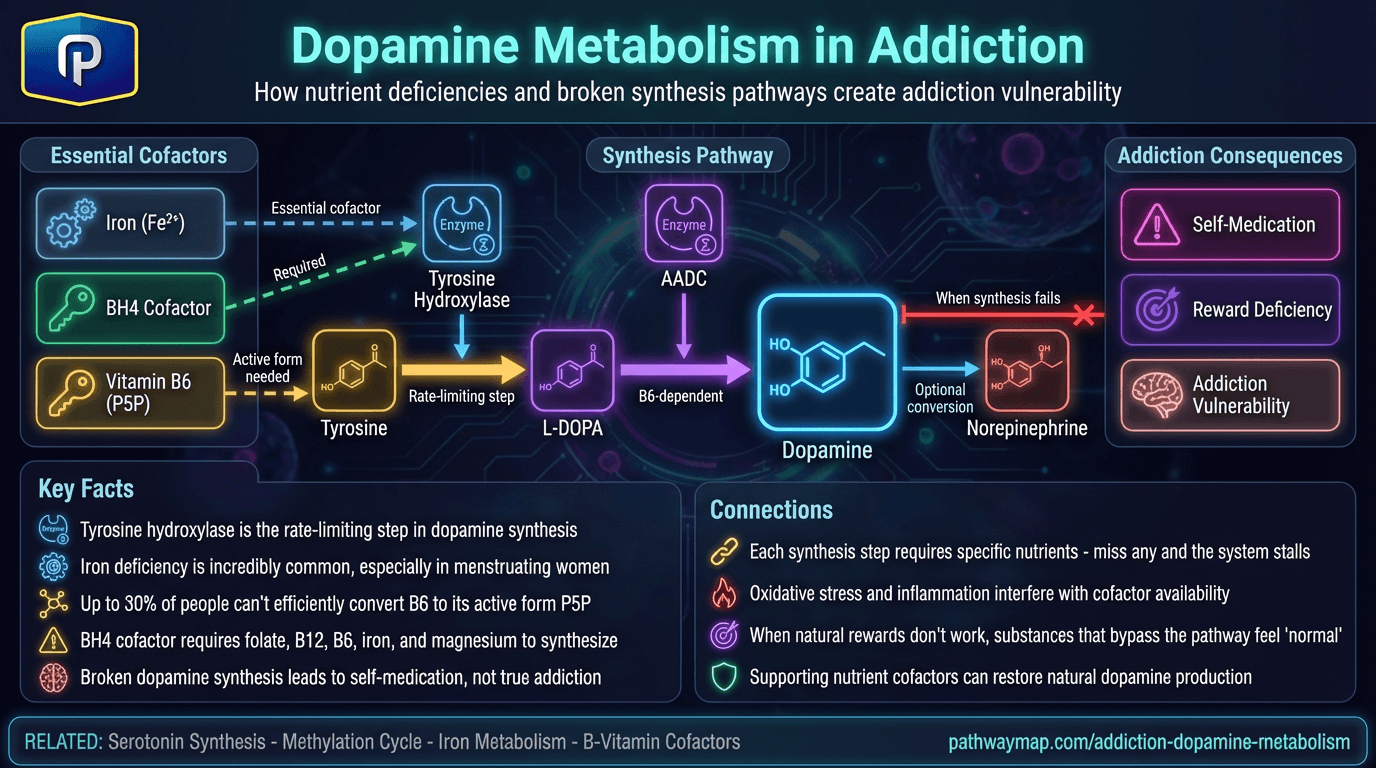
Dopamine doesn't just appear. Your body builds it step-by-step from the amino acid tyrosine:
Tyrosine → L-DOPA → Dopamine
Seems simple. But each step requires specific nutrients. Miss any of them, and the whole system stalls.
Step 1: Tyrosine → L-DOPA
Enzyme: Tyrosine hydroxylase (TH)
Required cofactors:
- Iron (Fe²⁺) - absolutely essential, enzyme won't function without it
- Tetrahydrobiopterin (BH4) - cofactor that must be regenerated after each reaction
- Oxygen - needed for the hydroxylation reaction
Tyrosine hydroxylase is the rate-limiting step in dopamine synthesis. It controls how much dopamine you can make. When it's impaired, everything downstream suffers.
What breaks this step:
- Iron deficiency (incredibly common, especially in menstruating women)
- BH4 deficiency (requires folate, B12, B6, iron, magnesium to synthesize)
- Oxidative stress (degrades BH4 rapidly)
- Inflammation (interferes with iron availability)
Step 2: L-DOPA → Dopamine
Enzyme: Aromatic amino acid decarboxylase (AADC)
Required cofactor:
- Vitamin B6 as pyridoxal-5-phosphate (P5P)
AADC requires the active form of B6 (P5P), not regular pyridoxine. Here's the problem: up to 30% of people can't efficiently convert pyridoxine to P5P. They can take B6 supplements all day and remain functionally deficient.
What breaks this step:
- B6 deficiency (common with poor diet, gut issues, certain medications)
- P5P conversion impairment (genetic variants in PDXK and PNPO genes)
- Competition (same enzyme converts 5-HTP to serotonin—imbalance possible)
Step 3: Dopamine → Norepinephrine (Optional)
Enzyme: Dopamine beta-hydroxylase (DBH)
Required cofactors:
- Copper (Cu²⁺)
- Vitamin C (ascorbic acid)
While this step produces norepinephrine rather than staying as dopamine, understanding it matters because excessive conversion can deplete dopamine. Some people need norepinephrine support, others need to preserve dopamine.
What breaks this step:
- Copper deficiency (can happen with excess zinc supplementation)
- Vitamin C deficiency (less common but possible)
- DBH genetic variants (affecting conversion efficiency)
Dopamine Clearance: COMT and MAO
Making dopamine is only half the story. You also need to clear it properly.
COMT (Catechol-O-Methyltransferase)
COMT breaks down dopamine by adding a methyl group. The speed of this enzyme varies dramatically between people.
COMT Variants:
- Val/Val (warrior) - Fast COMT, clears dopamine quickly, low baseline dopamine but handles stress well
- Met/Met (worrier) - Slow COMT, dopamine lingers longer, higher baseline but stress-sensitive
- Val/Met (mixed) - Intermediate function
Required cofactors:
- Magnesium (essential for enzyme function)
- SAMe (methyl donor, from methylation cycle)
- Methylfolate, B12, B6 (methylation support)
What breaks this:
- Magnesium deficiency (extremely common)
- Methylation impairments (MTHFR variants compound the issue)
- Fast COMT + inadequate synthesis = chronic dopamine deficiency
MAO (Monoamine Oxidase)
MAO-A and MAO-B break down dopamine through oxidation. This produces toxic metabolites like DOPAL (3,4-dihydroxyphenylaldehyde) that must be further processed.
What breaks this:
- Oxidative stress (impairs clearance of toxic metabolites)
- Mercury and heavy metals (inhibit aldehyde dehydrogenase, cause DOPAL accumulation)
- Excessive MAO activity (some genetic variants)
Receptor Function: D1, D2, D3, D4, D5
Having dopamine is pointless if receptors don't respond properly.
D2 Receptors (Most Important for Addiction)
D2 receptor density determines reward sensitivity. Lower D2 receptors = less pleasure from natural rewards.
Studies show people with lower D2 receptors experience reduced satisfaction from food, social interaction, and accomplishments. They're biologically wired to find normal life unrewarding.
What reduces D2 receptors:
- Chronic excessive dopamine stimulation (substance use, behavioral addictions)
- Inflammation (cytokines directly reduce receptor expression)
- Genetic variants (DRD2 Taq1A polymorphism)
- Nutrient deficiencies affecting receptor synthesis
What increases D2 receptors:
- Abstinence (receptors upregulate, but slowly—weeks to months)
- Exercise (natural dopamine stimulus with receptor upregulation)
- Proper nutrient status
- Reduced inflammation
Other Receptors
- D1 - Motivation, working memory, attention
- D3 - Implicated in addiction vulnerability and relapse
- D4 - Novelty seeking, risk-taking behavior
- D5 - Working memory, decision-making
Each requires proper synthesis, but D2 is most critical for reward and addiction vulnerability.
The Nutrient Requirements
To make and use dopamine properly, you need:
Tyrosine (The Precursor)
Dietary Sources: Chicken, turkey, fish, eggs, dairy, almonds, avocados, bananas
Supplemental Dose: 500-2000mg daily, taken in morning on empty stomach
Studies show tyrosine supplementation improves cognitive function during stress and reduces subjective fatigue. It provides the raw material for dopamine synthesis when dietary intake is insufficient or demand is high.
Important: Tyrosine competes with tryptophan (serotonin precursor) for absorption. Take separately—tyrosine in morning, tryptophan/5-HTP in evening.
Iron
Critical for: Tyrosine hydroxylase function
Testing: Ferritin should be 50-100 ng/mL minimum for optimal TH function (conventional "normal" of >15 is inadequate)
Supplemental Dose: 15-25mg elemental iron daily for deficiency, preferably as ferrous bisglycinate (gentle on stomach)
Warning: Test before supplementing. Excess iron is oxidizing and harmful.
Signs of deficiency: Fatigue, brain fog, restless legs, ice cravings, anhedonia
Vitamin B6 as P5P
Critical for: L-DOPA → dopamine conversion
Supplemental Dose: 25-50mg P5P daily (use P5P, not pyridoxine)
Why P5P matters: Bypasses the conversion step that up to 30% of people can't do efficiently.
Signs of deficiency: Depression, irritability, confusion, peripheral neuropathy
BH4 (Tetrahydrobiopterin) Support
You can't supplement BH4 directly (oral forms don't work well), so you support its synthesis:
BH4 synthesis requires:
- Folate (methylfolate) 400-800mcg
- Magnesium 400-600mg
- Iron (adequate ferritin)
- Vitamin C 500-2000mg (BH4 is easily oxidized)
Antioxidants to preserve BH4:
- Vitamin E
- Alpha-lipoic acid
- Glutathione (NAC, glycine support)
Copper
Critical for: Dopamine → norepinephrine conversion
Supplemental Dose: 1-2mg daily (usually included in multivitamins)
Balance with zinc: Taking 30mg+ zinc daily without copper creates deficiency. Always balance.
Testing: Serum copper, ceruloplasmin
Magnesium
Critical for: COMT function, hundreds of other enzymes
Supplemental Dose: 400-600mg daily (glycinate, threonate, or malate forms best)
Studies show chronic magnesium deficiency impairs dopamine release and receptor function.
Signs of deficiency: Muscle cramps, anxiety, insomnia, irregular heartbeat, chocolate cravings
Methylation Support (for COMT)
Methylfolate: 400-800mcg Methylcobalamin (B12): 1000mcg Trimethylglycine (TMG): 500-2000mg (if MTHFR variants or slow methylation)
These support the methylation cycle that provides methyl groups for COMT to clear dopamine.
The Genetics Question
Yes, genetic variants affect dopamine metabolism:
COMT variants:
- Val/Val (fast) - Need more dopamine synthesis support
- Met/Met (slow) - Need methylation support for clearance
DRD2 variants:
- Taq1A polymorphism - Fewer D2 receptors from birth
MTHFR variants:
- C677T, A1298C - Impaired methylation affecting COMT, BH4 synthesis
TH variants:
- Rare, but affect tyrosine hydroxylase efficiency
AADC variants:
- Rare, but affect B6-dependent decarboxylase
But here's what matters: genetics operate within a metabolic context.
Someone with "bad" COMT genetics but optimal magnesium, methylation support, and low inflammation? Often minimal symptoms.
Someone with "good" genetics but severe iron deficiency, B6 depletion, and chronic oxidative stress? Significant dopamine dysfunction.
Genes load the gun. Environment determines whether there are bullets.
Dopamine Deficiency Signs
How do you know if dopamine is your issue? Look for this cluster:
Psychological:
- Anhedonia (inability to feel pleasure)
- Lack of motivation
- Difficulty initiating tasks
- Flat affect, emotional blunting
- Can't sustain interest in previously enjoyed activities
Physical:
- Fatigue despite adequate sleep
- Low libido
- Restless legs
- Cravings for stimulating substances (caffeine, nicotine, stimulants)
Behavioral:
- Procrastination
- Difficulty with focus and sustained attention
- Seeking novelty/excitement to feel anything
- Using substances or behaviors that spike dopamine (drugs, gambling, risk-taking)
Response pattern:
- Stimulating substances provide disproportionate relief
- "Normal" life feels gray and meaningless
- Brief moments of normal feeling when dopamine spikes
- Crash after dopamine surge feels worse than baseline
The Restoration Protocol
Foundation (4-8 weeks)
Start here regardless of genetics:
Morning:
- Tyrosine 500-1000mg (empty stomach)
- Iron 15-25mg (if deficient, with vitamin C)
- B-complex with P5P 25-50mg
- Vitamin C 500-1000mg
Throughout day:
- Magnesium glycinate 400-600mg (split doses)
- Methylfolate 400-800mcg
- Methylcobalamin 1000mcg
Antioxidant support:
- NAC 1200-1800mg (glutathione for BH4 preservation)
- Alpha-lipoic acid 300-600mg
- Vitamin E 400IU
Add If Needed (Based on Response)
If limited response after 4-6 weeks:
- Increase tyrosine to 1500-2000mg
- Add DLPA (D,L-phenylalanine) 500-1500mg for endorphin support
- Test ferritin (should be 50-100 ng/mL minimum)
- Test for copper deficiency if supplementing high zinc
If methylation seems impaired (slow COMT suspected):
- Add TMG 1000-2000mg
- Ensure adequate methylfolate, B12
- Consider SAMe 400-800mg (expensive but effective)
If D2 receptor upregulation needed:
- Exercise (critical—natural stimulus for receptor upregulation)
- Abstinence from excessive dopamine stimulation
- Omega-3s 2-4g (support receptor synthesis)
- Time (receptors upregulate slowly, requires patience)
Timeline Expectations
Week 1-2: May feel worse (especially if detoxing from substances). Support systems, don't give up.
Week 3-6: Energy starts improving, motivation increases slightly, cravings may reduce
Week 6-12: Natural rewards begin providing satisfaction again, baseline mood improves
Month 3-6: Sustained improvement, D2 receptors beginning to upregulate, substances lose appeal
Long-term: Continue foundation support, reduce doses if symptoms resolve, maintain lifestyle factors
What Actually Works
I'm not theoretical about this. Dopamine restoration works when you:
- Test deficiencies (don't guess—test ferritin, B vitamins, copper, magnesium)
- Provide substrates (tyrosine, cofactors)
- Support synthesis (iron, B6, BH4 pathway)
- Support clearance (magnesium, methylation)
- Reduce oxidative stress (antioxidants)
- Give receptors time to upregulate (exercise, abstinence, patience)
Result: Food tastes good again. Accomplishments feel satisfying. Music gives chills. Social connection provides pleasure. Work provides fulfillment.
That's not managing addiction. That's restoring normal dopamine function.
The Bottom Line
Dopamine synthesis requires tyrosine, iron, B6, magnesium, copper, folate, B12, vitamin C, and a functioning methylation cycle. Receptor function requires proper synthesis plus time and stimulus to upregulate.
Deficiency in any of these creates vulnerability. Substances that bypass broken pathways feel like survival, not recreation.
Fix the synthesis pathway. Support clearance. Give receptors time. Natural rewards start working again.
Dopamine dysfunction isn't genetic destiny. It's modifiable metabolic biochemistry.
Further Reading
- Addiction: The Metabolic Crisis - Overview of all systems
- Addiction Research - Comprehensive literature review
- Root Causes of Addiction - How systems interact
- Metabolic Recovery Protocols - Tiered implementation