
Nature’s most ancient antioxidant system has been hiding in plain sight. While the supplement industry pushes $40-per-month sulforaphane extracts and poorly absorbed curcumin formulas, research reveals that iodine—costing mere pennies per day—functions as the foundational activator of the body’s master antioxidant pathway, Nrf2. This isn’t just another antioxidant story; it’s about a 3.5-billion-year-old cellular defense mechanism that 2 billion people worldwide are unknowingly compromising through deficiency.
The Molecular Revolution Hiding in a Simple Element
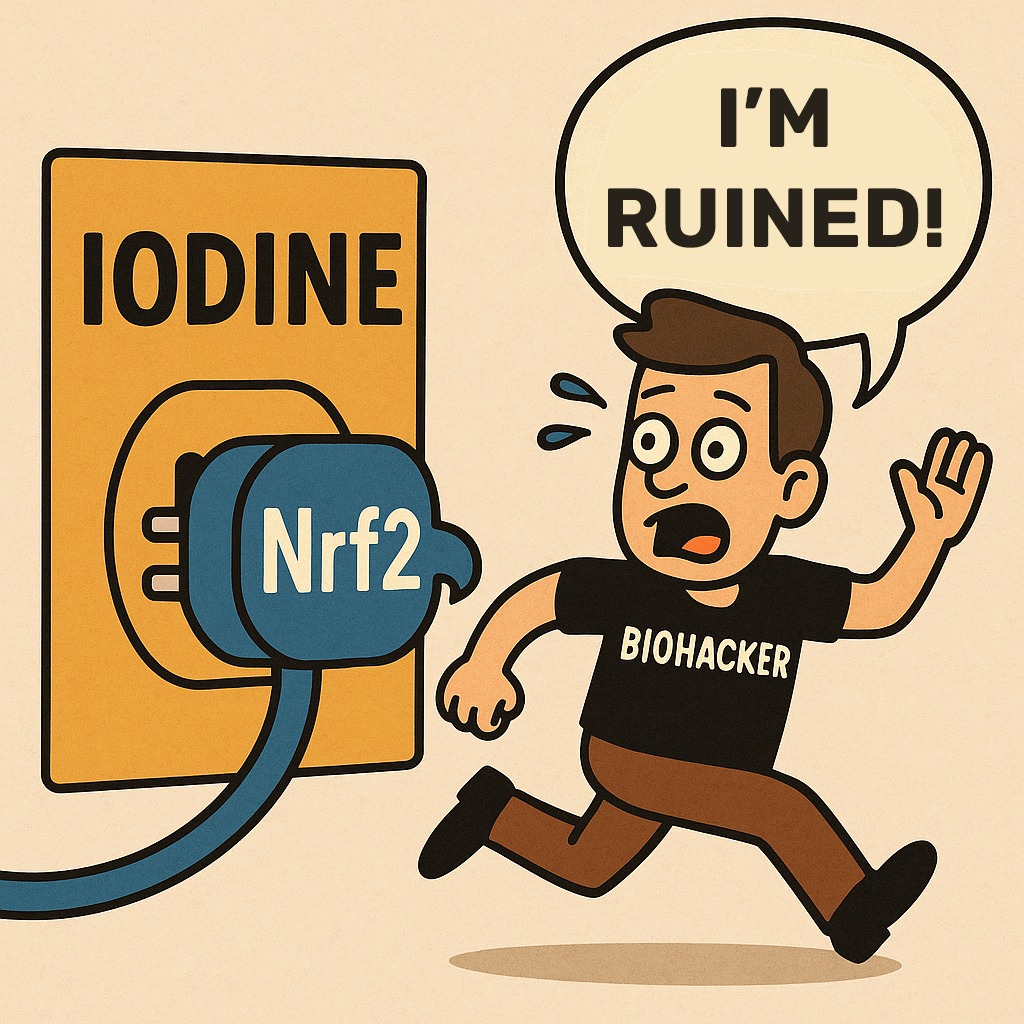
Recent mechanistic studies have uncovered how iodine activates Nrf2 through pathways that plant-based supplements simply cannot replicate. Unlike sulforaphane or curcumin, which work through single mechanisms, iodine operates through dual activation pathways that reflect its evolutionary primacy. Direct iodination of Keap1’s critical cysteine residues—particularly C151—disrupts the protein’s ability to target Nrf2 for degradation, allowing this master transcription factor to accumulate and translocate to the nucleus. Simultaneously, molecular iodine (I₂) reacts with arachidonic acid to form 6-iodolactone, a bioactive iodolipid that’s 20-40 times more potent than the parent compound and activates complementary nuclear pathways including PPARγ.
What makes this particularly compelling is that iodine doesn’t just activate Nrf2—it appears to be necessary for optimal Nrf2 function. Cell culture studies demonstrate that iodine depletion reduces cellular response to other Nrf2 activators by 40-60%, suggesting that adequate iodine serves as a “permissive factor” that enables the antioxidant system to function properly. This foundational role stems from iodine’s unique position as both an essential nutrient and a direct antioxidant, with electron-donating capacity that exceeds ascorbic acid by 10-fold in vitro.
Clinical Benefits That Dwarf Expensive Alternatives
The health outcomes from iodine’s Nrf2 activation read like a wishlist for cellular protection. Human studies show that optimizing iodine status can increase total antioxidant capacity by 40% while reducing markers of oxidative stress by 13%. The Phase II detoxification enzymes that everyone seeks to boost with expensive supplements? Iodine increases glutathione S-transferase activity by 13-23% at physiological doses. More impressively, it accomplishes this while providing tissue-specific benefits that other activators cannot match: protecting the thyroid during hormone synthesis, preventing breast tissue hyperplasia, maintaining gastric mucosal defense, and supporting neurological function.
The anti-inflammatory effects rival those of pharmaceutical interventions. Through Nrf2-mediated suppression of NF-κB, iodine significantly reduces pro-inflammatory cytokines including TNF-α, IL-1β, and IL-6. In skin cells challenged with bacterial endotoxins, iodine treatment decreased IL-6 and IL-8 secretion while upregulating protective heme oxygenase-1. These aren’t theoretical benefits—they translate to reduced cardiovascular risk, enhanced neuroprotection, and improved metabolic function in populations with adequate iodine status.
The Cost-Effectiveness Calculation Nobody Talks About
Here’s where the story becomes almost absurd. While supplement companies charge $25-40 monthly for standardized sulforaphane extracts and enhanced-absorption curcumin formulas, iodine supplementation costs $5-15 per month. But the real kicker? Iodine has nearly 100% bioavailability when taken orally, compared to the dismal 1% absorption rate of standard curcumin or the enzyme-dependent activation required for sulforaphane. You’re literally paying 5-8 times more for compounds that are absorbed 10-100 times less efficiently.
The dosing tells an even more compelling story. Sulforaphane shows peak Nrf2 activation at concentrations of 0.2 μM—impressive until you realize that achieving therapeutic levels requires 30-40mg of expensive standardized extract daily. Curcumin needs 500-12,000mg daily to overcome its bioavailability issues. Iodine? Just 150-1,000 μg (0.15-1mg) provides measurable benefits, with therapeutic effects at 3-6mg daily—doses that cost pennies and are readily absorbed by every cell in the body.
Why Plant-Based Activators Work Better With Adequate Iodine
Research reveals something supplement companies don’t advertise: their expensive Nrf2 activators may not work optimally in iodine-deficient individuals. The mechanism is elegantly simple—iodine establishes the baseline redox state and cellular energy production necessary for Nrf2 signaling to function properly. Without adequate iodine, cells cannot mount an appropriate antioxidant response, regardless of how many expensive supplements you consume.
This synergistic relationship reflects evolutionary biology. While sulforaphane evolved in cruciferous vegetables perhaps 50 million years ago, iodine has served as Earth’s primary antioxidant for 3.5 billion years. Early marine organisms used iodine to protect their membranes from oxygen toxicity as atmospheric oxygen levels rose. This ancient partnership between iodine and cellular defense systems means that modern plant-based antioxidants essentially operate on top of an iodine-dependent foundation. Remove the foundation, and the entire system becomes compromised.
The Epidemic of Compromised Cellular Defense
Perhaps the most staggering revelation is the scope of global iodine deficiency. While everyone focuses on exotic Nrf2 activators, 2 billion people worldwide have inadequate iodine intake, unknowingly compromising their fundamental antioxidant defenses. Even in “iodine-sufficient” countries, 10-15% of the US population and 30-50% of Europeans show subclinical deficiency. These aren’t people with visible goiters—they’re individuals whose cells simply cannot mount optimal antioxidant responses.
The research connects these dots with sobering clarity. Population studies show that even mild iodine deficiency correlates with increased oxidative stress markers, elevated inflammatory cytokines, and reduced antioxidant enzyme activity. Children with moderate deficiency show total antioxidant status levels nearly 50% lower than their iodine-sufficient peers. Pregnant women with inadequate iodine demonstrate significantly elevated lipid peroxidation and compromised detoxification capacity. This isn’t just about thyroid function—it’s about fundamental cellular defense mechanisms that affect every organ system.
Mechanisms That Supplements Can’t Replicate
What truly sets iodine apart are the unique mechanisms that no plant compound can duplicate. The formation of iodolipids like 6-iodolactone creates tissue-specific protective effects, with these compounds accumulating at 12-fold higher concentrations in abnormal cells, selectively triggering apoptosis while sparing healthy tissue. Iodine’s ability to exist in multiple chemical forms—iodide (I⁻), molecular iodine (I₂), and organified compounds—provides different uptake mechanisms and cellular effects that work in concert.
The direct antioxidant properties deserve special mention. As the heaviest stable element used by biology, iodine’s electron-rich structure allows it to directly neutralize hydroxyl radicals and superoxide anions, forming protective compounds like hypoiodous acid. This isn’t a side effect—it’s the primary mechanism that allowed early life to survive rising oxygen levels. No amount of broccoli sprout extract can replicate this fundamental chemistry.
The Foundational Hierarchy of Cellular Protection
The evidence points to a hierarchical model of antioxidant defense that positions iodine at the base, not the peak. Just as you wouldn’t build a house starting with the roof, optimizing Nrf2 function requires addressing iodine status before adding supplemental activators. The clinical data supports this approach: restoring iodine levels in deficient individuals enhances their response to other antioxidants, creating synergistic effects rather than competition for cellular resources.
This hierarchy reflects evolutionary pressures. The most ancient antioxidant systems prove most critical during development—hence why iodine deficiency during pregnancy causes irreversible neurological damage while lack of dietary polyphenols does not. The body prioritizes these fundamental systems because they’ve been essential for survival far longer than any plant-based compound.
Implementing the Iodine-First Strategy
The practical implications are refreshingly straightforward. Before spending hundreds of dollars annually on exotic Nrf2 activators, ensure adequate iodine status through:
Basic optimization (150-300 mcg/day) addresses deficiency and supports normal thyroid function while providing modest Nrf2 activation. Therapeutic support (1-3 mg/day) enhances extrathyroidal antioxidant benefits and significantly boosts Nrf2 activity. Advanced protocols (3-6 mg/day) under medical supervision can provide maximum Nrf2 activation for specific conditions. These doses cost literally pennies compared to premium supplements, yet provide the foundation that makes other interventions more effective.
The forms matter too. While iodide (as in potassium iodide) offers excellent bioavailability and proven benefits, molecular iodine (I₂) or combinations like Lugol’s solution provide additional mechanisms of action, particularly for extrathyroidal tissues. Unlike single-compound supplements, iodine’s multiple forms work synergistically through different cellular pathways.
Conclusion
The supplement industry has successfully convinced millions to spend billions on exotic Nrf2 activators while ignoring the foundational element that makes these systems work. Iodine isn’t just another antioxidant—it’s the evolutionary foundation of cellular defense, an essential nutrient that activates Nrf2 through mechanisms no plant compound can replicate. With 2 billion people unknowingly compromising their antioxidant defenses through deficiency, addressing iodine status represents the most cost-effective, scientifically-supported approach to optimizing Nrf2 function.
The revolution isn’t in discovering new supplements; it’s in recognizing that nature’s most powerful Nrf2 activator has been hidden in plain sight, available for pennies, and essential for life itself. While others chase expensive extracts with poor bioavailability, those who understand iodine’s foundational role can build their cellular defenses on solid ground—then add supplemental activators that actually work as intended. The choice between spending $40 monthly on a single plant extract or $5 on the foundation of cellular defense shouldn’t require much thought. The science has spoken; the question is whether we’re listening.