Folate
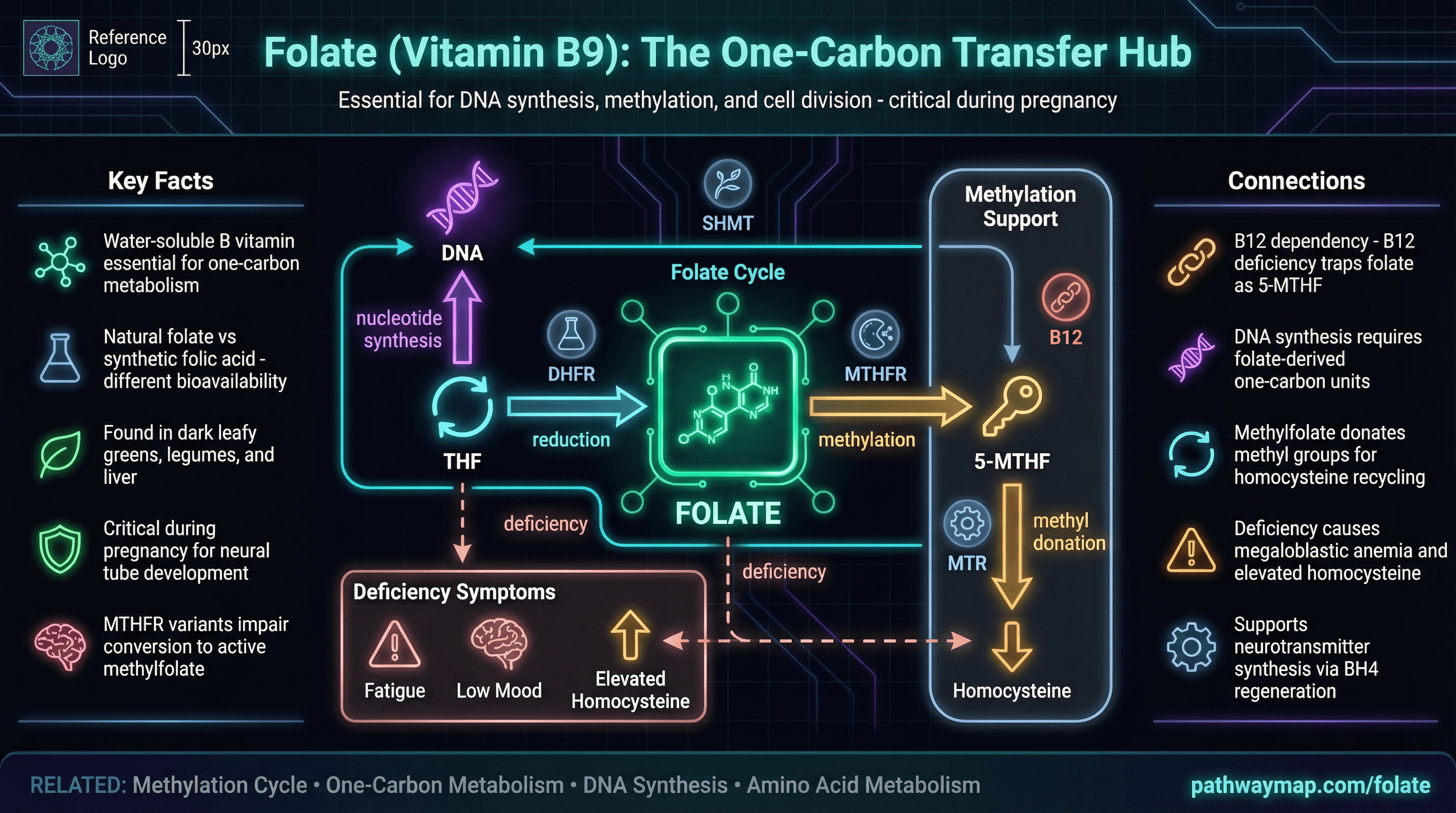
Vitamin B9—essential for one-carbon metabolism, DNA synthesis, and methylation. Critical during pregnancy and increasingly important to understand with MTHFR variants.
🌿 Folate vs. Folic Acid: A Critical Distinction
Folate (Natural)
- • Found naturally in food (leafy greens, liver, legumes)
- • Easily converted to active forms
- • No accumulation concerns
- • Works with natural metabolic pathways
Folic Acid (Synthetic)
- • Synthetic form used in supplements and fortification
- • Requires DHFR enzyme (slow in humans) for conversion
- • Can accumulate as unmetabolized folic acid (UMFA)
- • May mask B12 deficiency; potential concerns with excess
Methylfolate (5-MTHF) is the active, methylated form that bypasses MTHFR entirely. While commonly recommended for MTHFR variants, consider whether your body's slower methylation is protective before supplementing aggressively. Some respond poorly to methylfolate supplementation.
🏭 How Methylfolate is Manufactured
Unlike natural folate from food, supplemental methylfolate (5-MTHF) requires complex chemical synthesis or biotechnological production. Understanding the manufacturing process helps explain cost differences and quality variations between products.
Manufacturing Methods
1. Chemical Synthesis
The traditional method involves multi-step chemical synthesis starting from pteridine and para-aminobenzoic acid derivatives. The methylation and reduction steps require precise control to achieve the correct L-form stereochemistry (the biologically active version).
2. Biotechnological/Fermentation
Some manufacturers use engineered bacteria or yeast strains that produce 5-MTHF through their metabolic pathways. This approach can yield higher purity and better stereochemical selectivity, but requires significant expertise in fermentation technology.
Key Manufacturing Challenges
Stability Issues
Methylfolate is highly sensitive to light, heat, oxygen, and moisture. It degrades rapidly if not properly protected, making formulation and storage critical.
Stereochemistry
Only the L-form (also called 6S form) is biologically active. Manufacturing must ensure the correct isomer; the presence of D-form reduces efficacy and increases cost per active dose.
Purity Control
Synthesis can produce side products and contaminants. High-grade pharmaceutical methylfolate requires extensive purification steps (chromatography, crystallization), adding to costs.
Salt Forms
Methylfolate is typically sold as calcium salt (Metafolin®) or glucosamine salt (Quatrefolic®) to improve stability. These different forms have varying bioavailability and manufacturing complexity.
Why does this matter? Manufacturing complexity explains why methylfolate supplements are significantly more expensive than folic acid. It also means quality varies widely between brands— factors like purity, stability, and correct stereochemistry directly affect how well the supplement works. Third-party testing (USP, NSF certification) helps verify quality.
🔄 The Folate Cycle
The folate cycle is a system of interconversions that allow folate to carry and donate "one-carbon" units for various reactions. Think of it as a delivery service for molecular building blocks.
THF (Tetrahydrofolate)
The "empty carrier"—ready to pick up one-carbon units from amino acid metabolism.
5,10-Methylene-THF
Used for DNA synthesis (making thymidine). Also the substrate for MTHFR.
5-Methyl-THF (Methylfolate)
The methyl donor form. Gives its methyl to homocysteine (requires B12).
🧬 Core Functions
DNA Synthesis
Required for making thymidine (DNA base). Rapidly dividing cells need abundant folate.
Methylation Support
Methylfolate donates its methyl group to regenerate methionine and SAM-e.
Amino Acid Metabolism
Involved in histidine, serine, and glycine interconversions.
Neurotransmitter Support
Indirectly supports BH4 regeneration for serotonin and dopamine synthesis.
🥗 Food Sources
Excellent Sources
- • Liver (chicken, beef) - highest natural source
- • Dark leafy greens (spinach, kale, collards)
- • Legumes (lentils, black beans, chickpeas)
Good Sources
- • Asparagus, Brussels sprouts, broccoli
- • Avocado
- • Eggs
- • Beets
Note: Folate is heat-sensitive. Raw or lightly cooked vegetables retain more folate.
🧬 The MTHFR Connection
MTHFR (methylenetetrahydrofolate reductase) is the enzyme that converts 5,10-methylene-THF into methylfolate. Common genetic variants reduce this enzyme's efficiency:
C677T Variant
Heterozygous (one copy): ~30% reduced activity
Homozygous (two copies): ~60-70% reduced activity
A1298C Variant
Milder effect on methylfolate production.
May affect BH4 recycling more significantly.
A different perspective: MTHFR variants may not be a "defect" to fix. Research suggests reduced methylation could be protective—slowing oxidative stress generation from the methylation cycle when the body is already under metabolic pressure.
Rather than automatically supplementing methylfolate to "bypass" MTHFR, consider whether your body intentionally slowed this pathway. Focus on reducing toxic burden, supporting detox capacity, and ensuring cofactors (B2, B12, magnesium) before forcing methylation higher.
Learn more: MTHFR as Purposeful Slowdown
🪤 The Methyl Trap
"Methyl trap" describes what happens when B12 is deficient: methylfolate accumulates because it can't donate its methyl group without B12. This creates a functional folate deficiency despite adequate folate intake.
This is why B12 and folate should be assessed and addressed together—they are metabolically inseparable.
🚨 Signs of Folate Deficiency
Blood & Energy
- • Megaloblastic anemia (large red blood cells)
- • Fatigue and weakness
- • Shortness of breath
Neurological & Mood
- • Depression and irritability
- • Cognitive difficulties
- • Elevated homocysteine (cardiovascular risk)
Physical Signs
- • Glossitis (smooth, sore tongue)
- • Mouth ulcers
- • Poor wound healing
Pregnancy
- • Neural tube defects (spina bifida, anencephaly)
- • Increased miscarriage risk
- • Low birth weight
Metabolic Connections

MTHFR
Converts methylenetetrahydrofolate to methylfolate—the rate-limiting step

Vitamin B12
B12 and methylfolate work together to power methylation

Methylation
Methylfolate is the primary folate form that donates methyl groups

Homocysteine
Folate (with B12) recycles homocysteine back to methionine

Vitamin B6
B6 is needed for folate cycle enzymes SHMT and CBS

Choline
Alternative methyl donor—can compensate for low folate