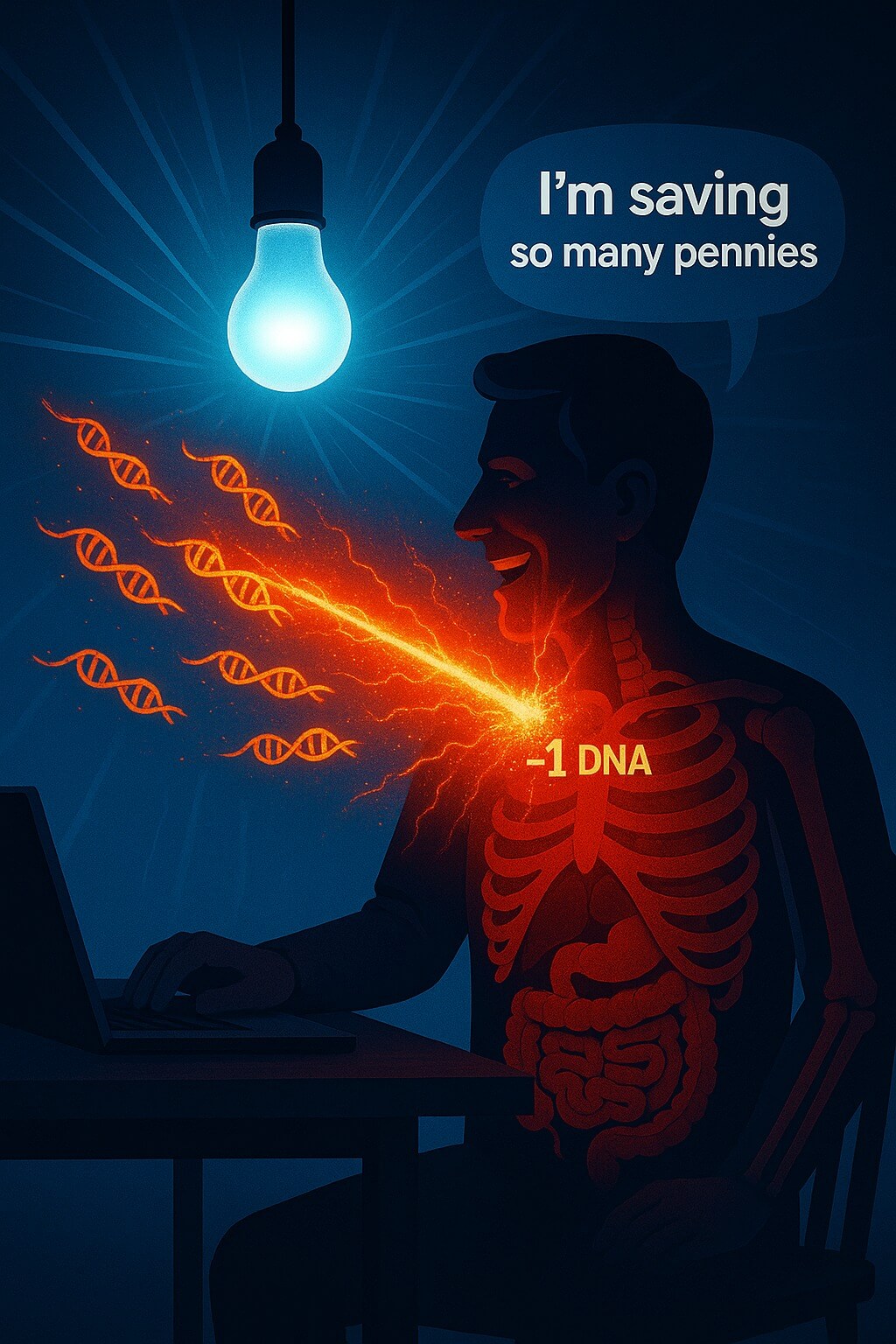

Modern artificial lighting presents a unique biological concern: the toxic compounds used to generate light in LEDs and fluorescent bulbs are simultaneously accumulating in human tissues. This creates an unprecedented situation where we're exposed to specific light wavelengths generated by the very compounds building up in our bodies, potentially enabling novel photochemical interactions that don't occur under natural sunlight.
The Core Problem: Dual Presence in Light and Tissue
We face an unprecedented biological experiment. The compounds generating our artificial light—gallium, arsenic, indium, aluminum, and mercury—are the same ones accumulating in our tissues. When tissue-accumulated compounds are exposed to the specific wavelengths they emit in LEDs, they may undergo electronic transitions and photochemical reactions absent in natural light.
Part 1: Compounds in Modern Lighting
LED Semiconductor Compounds
- Gallium Nitride (GaN): Generates blue and green light – 98% of gallium consumption in the US goes to semiconductor applications
- Gallium Arsenide (GaAs): Red and infrared LEDs – combines two toxic elements used in LEDs and instrumentation
- Indium Gallium Nitride (InGaN): Blue and white LEDs – the basis of ubiquitous white LEDs commercialized in 1993
- Aluminum Gallium Nitride (AlGaN): UV and blue wavelengths
Fluorescent Lamp Components
Mercury vapor generates the UV light needed for fluorescence, with average CFL bulbs containing 5mg of mercury, while older linear tubes can contain up to 115mg.
Part 2: Bioaccumulation Mechanisms and Distribution
Gallium: The Iron Mimic
Tissue Distribution:
- Gallium has no known physiologic function in the human body, with total mass in a 70kg human estimated at <700μg
- Gallium concentrates in bones and can substitute for iron in biological processes
- When gallium trichloride aerosols are inhaled, gallium is retained in the alveoli and not absorbed, inducing pulmonary consolidation
Biological Interference: Gallium interferes with iron acquisition by M. tuberculosis within macrophage phagosomes, resulting in bactericidal action
Arsenic: The Cellular Disruptor
Accumulation Pattern:
- The remaining unbound arsenic (≤10%) accumulates in cells, leading to skin, bladder, kidney, liver, lung, and prostate cancers
- Humans acquire arsenic as iAs and MMA in skin, hair, nails, muscle, bones, and teeth during metabolism
- Continuous exposure to low concentrations (10 μg/L) results in liver and kidney bioaccumulation
Cellular Effects: Arsenic compounds block IKr and Iks channels while activating IK-ATP channels, disrupting oxidative phosphorylation and ATP synthesis
Indium: The Lung Accumulator
Mercury: The Neurotoxin
The estimated mercury level in human adults is 0.40 mg/kg due to biomagnification in the food chain
Aluminum: The Multi-System Disruptor
Distribution: 60% in bones, 25% in lungs, 10% in muscles, 3% in liver, 1% in brain, with 90% of plasma aluminum binding to transferrin
Cellular Impact:
- Aluminum exposure induces intense mineral imbalance and DNA oxidation in cardiac tissue
- Aluminum accumulates at bone mineralization fronts, disrupting calcification and leading to osteomalacia
- Al3+ exhibits high affinity to proteins, which it cross-links
Part 3: The Resonant Interaction Hypothesis
Photochemical Activation Mechanisms
Key Discovery: The phototoxicity threshold currently accepted is overestimated by a factor of 50 for blue light and 550 for white light
When accumulated compounds are exposed to their emission wavelengths:
- Electronic Excitation: Compounds may undergo the same electronic transitions they exhibit in LEDs
- ROS Generation: Light exposure produces reactive oxygen species leading to oxidative stress, with taurine and hypotaurine degradation pathways most perturbed
- Inflammatory Cascade: Green light in white LEDs induces 8-fold more macrophage invasion in retina than blue light content
Documented Photobiological Effects
Low doses of LED light induce caspase-independent apoptosis
Part 4: Synergistic Toxicity Mechanisms
Cellular Disruption Pathways
Multiple mechanisms converge when compounds are both present in tissue AND activated by their emission wavelengths:
- DNA Damage: Aluminum induces DNA oxidation; arsenic alters DNA methylation
- Mitochondrial Dysfunction: Arsenic inhibits pyruvate dehydrogenase and uncouples oxidative phosphorylation
- Protein Disruption: Aluminum cross-links proteins; indium inhibits protein synthesis via rough endoplasmic reticulum degranulation
- Ion Channel Disruption: Multiple compounds affect calcium, potassium, and sodium channels
Compound Interactions in Semiconductor Materials
Part 5: Clinical Manifestations
Documented Health Effects by Compound
Gallium
- Progressive lung damage with significant cytotoxic, inflammatory, and fibrogenic responses persisting 6-12 months after exposure
- Disruption of normal microbiome through antimicrobial effects
Indium
- IARC classified InP as probably carcinogenic to humans (Group 2A)
- Pulmonary effects include lung injury, inflammation, fibrosis, emphysema, and alveolar proteinosis
- Testicular damage observed with InAs, InP, and ITO exposure
Arsenic
- Long-term exposure causes cancer, skin lesions, cardiovascular disease, and diabetes
- Activates Kupffer cells leading to TNF-α signaling, hepatocyte apoptosis, and hepatic fibrosis
Mercury
Aluminum
- Pulmonary tissue damage with neutrophil infiltration, interstitial inflammation, and reduced alveolar macrophages
- Cardiomyocyte degeneration with myocarditis and fibrosis
Part 6: Vulnerable Populations
High-Risk Groups
- Semiconductor Workers: Direct occupational exposure to indium and gallium compounds
- Children & Pregnant Women: Vulnerable populations for mercury exposure, with developing fetuses at particular risk
- Renal Insufficiency Patients: Aluminum is cleared through kidneys – impaired clearance leads to accumulation
- Elderly: Accumulated lifetime exposure with decreased protective mechanisms
Part 7: Current Safety Standards Are Inadequate
Regulatory Failures:
- LEDs are not classified as toxic and are disposed of in regular landfills
- Low-intensity red LEDs contain up to 8 times the lead allowed by California law
- Current photobiological safety thresholds vastly underestimate actual toxicity
- "Every day we don't have a law that says you cannot replace an unsafe product with another unsafe product, we're putting people's lives at risk"
Part 8: The Unique Threat of Resonant Interactions
What makes this situation unprecedented is not just the individual toxicity of these compounds, but their dual presence:
The Perfect Storm
- Bioaccumulation: Compounds accumulate in specific tissues over time
- Constant Exposure: We're bathed in the specific wavelengths these compounds emit 12-16 hours daily
- Photochemical Activation: Accumulated compounds may respond to their own emission wavelengths
- Synergistic Effects: Multiple compounds interact, amplifying individual toxicities
- Novel Reactions: Photochemical processes that don't occur in nature
Conclusion: An Overlooked Public Health Crisis
The evidence reveals we've created an unprecedented biological experiment. We're simultaneously accumulating toxic semiconductor compounds in our tissues while bathing ourselves in the specific wavelengths they emit. This creates conditions for photochemical interactions that have never existed in human evolution.
The convergence of bioaccumulation and wavelength-specific exposure represents more than additive toxicity—it's a multiplicative threat where the same compounds generating our light are potentially being activated within our bodies by that very illumination.
Current safety standards fail to account for this resonant interaction between accumulated toxins and their emitted wavelengths. As researchers note, LED makers could reduce heavy metal concentrations or redesign with safer materials, especially if regulators required it. Until then, we continue an uncontrolled experiment with unknown long-term consequences for human health.
References
- Aluminum Toxicity – StatPearls – NCBI Bookshelf (2024, October 26). National Center for Biotechnology Information. https://www.ncbi.nlm.nih.gov/books/NBK609094/
- Aluminum Poisoning with Emphasis on Its Mechanism and Treatment of Intoxication – PMC. National Center for Biotechnology Information. https://pmc.ncbi.nlm.nih.gov/articles/PMC8767391/
- Aluminum: A potentially toxic metal with dose-dependent effects on cardiac bioaccumulation, mineral distribution, DNA oxidation and microstructural remodeling (2018, July 17). ScienceDirect. https://www.sciencedirect.com/science/article/abs/pii/S0269749118316063
- Are LED lights safe for human health? – European Commission. European Commission. https://health.ec.europa.eu/scientific-committees
- Arsenic (2022, December 7). World Health Organization. https://www.who.int/news-room/fact-sheets/detail/arsenic
- Arsenic poisoning – Wikipedia (2025). https://en.wikipedia.org/wiki/Arsenic_poisoning
- Arsenic toxicity: sources, pathophysiology and mechanism – PMC. National Center for Biotechnology Information. https://pmc.ncbi.nlm.nih.gov/articles/PMC10762673/
- A review on arsenic in the environment: bio-accumulation, remediation, and disposal – PMC. National Center for Biotechnology Information. https://pmc.ncbi.nlm.nih.gov/articles/PMC10186335/
- A Retrospection on Mercury Contamination, Bioaccumulation, and Toxicity in Diverse Environments (2023, September 5). MDPI. https://www.mdpi.com/2071-1050/15/18/13292
- Effect of Light Emitting Diodes (LED) Exposure on Vitreous Metabolites-Rodent Study – PMC. National Center for Biotechnology Information. https://www.ncbi.nlm.nih.gov/pmc/articles/PMC9861686/
- Factors affecting the toxicity of the element indium – PubMed. https://pubmed.ncbi.nlm.nih.gov/5125268/
- Gallium – Wikipedia (2025, July). https://en.wikipedia.org/wiki/Gallium
- Gallium poisoning: A rare case report – ScienceDirect (2011, October 18). https://www.sciencedirect.com/science/article/abs/pii/S0278691511005485
- Galium – an overview | ScienceDirect Topics. https://www.sciencedirect.com/topics/pharmacology-toxicology-and-pharmaceutical-science/galium
- Health effects of indium compounds in animal experiments – PMC. National Center for Biotechnology Information. https://pmc.ncbi.nlm.nih.gov/articles/PMC11894926/
- Human health risks from mercury exposure from broken compact fluorescent lamps (CFLs) – ResearchGate (2011, November 28). https://www.researchgate.net/publication/51853754
- Indium – an overview | ScienceDirect Topics. https://www.sciencedirect.com/topics/pharmacology-toxicology-and-pharmaceutical-science/indium
- Is Mercury from Fluorescent Lights Harmful? — TerraCycle Regulated Waste (2024, June 24). https://tcrwusa.com/blogs/news/is-mercury-from-fluorescent-lights-harmful
- Is mercury in fluorescent lamps the only risk to human health? A study of environmental mobility of toxic metals and human health risk assessment – ScienceDirect (2020, August 28). https://www.sciencedirect.com/science/article/abs/pii/S004565352032302X
- LED Lighting and Retinal Toxicity: A Clearer Picture (2023, October 20). Gavin Publishers. https://www.gavinpublishers.com/article/view/led-lighting-and-retinal-toxicity
- LEDs contain lead and other toxics – UC Irvine News (2011, February 10). https://news.uci.edu/2011/02/10/leds-contain-lead-and-other-toxics/
- Medical Applications and Toxicities of Gallium Compounds (2010, May 10). MDPI. https://www.mdpi.com/1660-4601/7/5/2337
- Mercury in Fluorescent Lighting: Unnecessary Health Risks & Actionable Solutions – CLASP (2022, October 31). https://www.clasp.ngo/research/all/mercury-in-fluorescent-lighting
- Pulmonary effects of exposure to indium and its compounds: cross-sectional survey of exposed workers and experimental findings in rodents (2022, December 20). Particle and Fibre Toxicology. https://particleandfibretoxicology.biomedcentral.com/articles/10.1186/s12989-022-00510-w
- Studies on the Toxicity and Distribution of Indium Compounds According to Particle Size in Sprague-Dawley Rats – PMC. National Center for Biotechnology Information. https://pmc.ncbi.nlm.nih.gov/articles/PMC4007045/
- The blue light hazard and its use on the evaluation of photochemical risk for domestic lighting. An in vivo study – ScienceDirect (2024, February 2). https://www.sciencedirect.com/science/article/pii/S0160412024000576
- The Dark Side of LED Lightbulbs | Scientific American (2024, February 20). https://www.scientificamerican.com/article/led-lightbulb-concerns/
- The Health Effects of Aluminum Exposure – PMC. National Center for Biotechnology Information. https://www.ncbi.nlm.nih.gov/pmc/articles/PMC5651828/
- Use of and Occupational Exposure to Indium in the United States – PMC. National Center for Biotechnology Information. https://pmc.ncbi.nlm.nih.gov/articles/PMC4476525/