
Key Finding: Research shows that light at 480nm is most effective for melatonin production and circadian rhythm regulation, while blocking 460-480nm wavelengths in the evening is essential for preventing melatonin suppression. Understanding which wavelengths to block—and when—can dramatically improve our sleep quality and reduce eye strain from digital devices.
The Science Behind Blue Light and Sleep
Research demonstrates that narrowband blue light at 469nm can suppress melatonin in a dose-dependent manner, with effects starting at very low light levels. Harvard researchers found that blue light suppressed melatonin for about twice as long as green light and shifted circadian rhythms by twice as much (3 hours vs. 1.5 hours).
The melanopsin photopigment in our retinal cells has peak sensitivity at 460-480nm wavelengths, which is why this specific range has such a powerful effect on our circadian rhythms. A systematic review found that a two-hour exposure to blue light (460nm) in the evening suppresses melatonin, with maximum suppression achieved at light levels common in everyday environments.
Critical Wavelength Ranges:
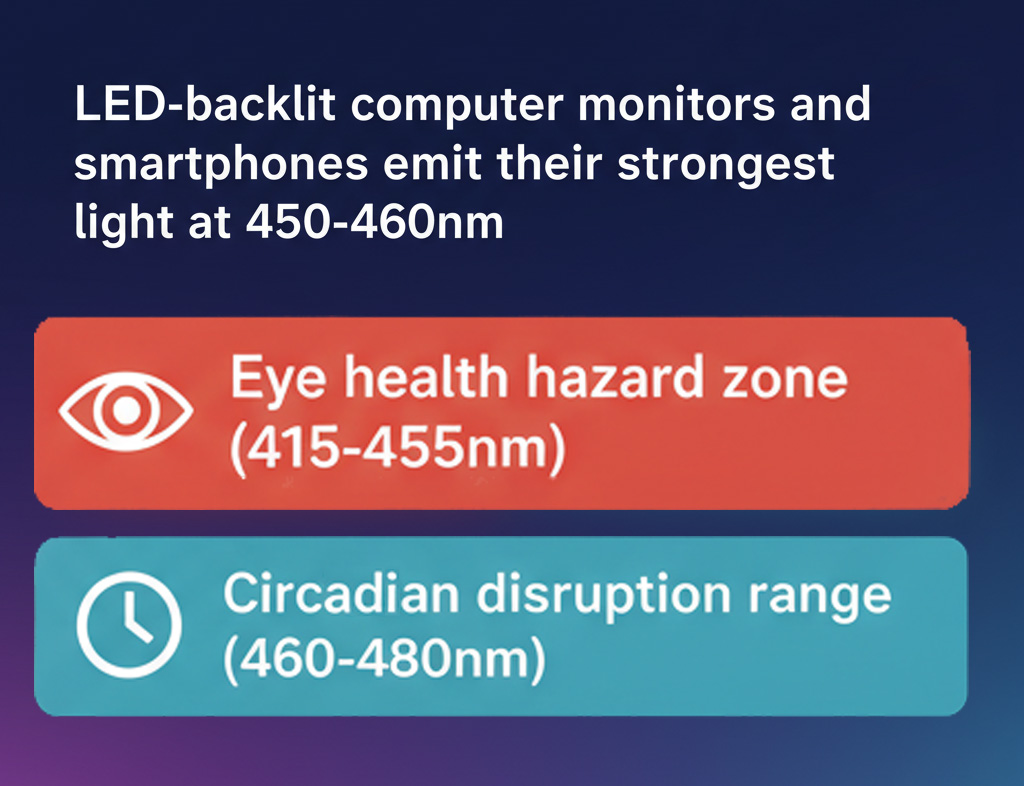
- 415-455nm: Associated with potential eye damage and digital eye strain
- 460-480nm: Primary range for melatonin suppression and circadian disruption
- 480nm specifically: Peak sensitivity for melanopsin and circadian regulation
What Our Devices Actually Emit
Smartphones emit blue light with peak emission around 450 nanometers, producing 20-40 cd/m² at maximum brightness. Research measuring actual device emissions found that all electronic devices tested showed maximum emission between 440nm and 460nm.
Most LED screens peak in the 435-440nm range, which is connected to significant concern in medical research. A 2024 comparative study found that iPhone, iPad, and MacBook Pro devices all showed enhanced blue peaks at 445-455nm.
Timing Matters: When to Block Which Wavelengths
Morning (6am-noon)
Morning exposure to bright light including 480nm wavelengths can help regulate circadian rhythms and improve alertness. During this time, we actually want exposure to blue light for proper circadian entrainment.
Afternoon (noon-6pm)
The afternoon represents a neutral zone where blue light has minimal circadian impact, allowing normal screen use without significant disruption.
Evening (after 6pm)
Evening exposure to LED devices can suppress and delay melatonin secretion, with effects starting at relatively dim light levels (<30 lux). Even 8 lux—about twice the brightness of a night light—can interfere with melatonin production.
Blue Light Blocking Glasses: Specifications That Matter
Daytime Computer Glasses
Swanwick Day Swannies block 98% of blue light at 400nm, graduating to 45% at 450nm, while allowing beneficial 450-500nm wavelengths through for daytime alertness. These clear or lightly tinted lenses are designed for all-day computer use.
Felix Gray claims their lenses filter up to 15x more blue light than other clear lenses and are clinically proven to increase natural melatonin secretion by up to 2x, though this is based on company-commissioned research.
Evening/Night Glasses
Swanwick Night Swannies block over 99% of blue light from 400-500nm, with the orange-amber tint being most effective in blocking the 450-480nm wavelength range.
GUNNAR glasses publish their GBLF (Blue Light Protection Factor) rating, with their amber lenses blocking 65% of blue light at 450nm, while their clear lenses block 35% and their AMBER Max lenses block 98% at the same wavelength.
Price Ranges and Options
Zenni Optical’s Blokz lenses start at $16.95 and filter blue light wavelengths, offering an affordable entry point. Mid-range options like GUNNAR Optiks ($60-120) provide certified blue light blocking with published specifications.
Software Solutions and Complementary Approaches
Software like f.lux and Night Shift automatically adjust displays by shifting screen color temperatures toward the warmer end of the spectrum at night. Researchers are developing “human-centric” LEDs that emit at 475nm for daytime use and 450nm for evening use to better align with our circadian needs.
Screen brightness matters—reducing brightness to 50% cuts blue light emission proportionally across all wavelengths. The 20-20-20 rule (looking at something 20 feet away for 20 seconds every 20 minutes) helps reduce eye strain regardless of blue light exposure.
Practical Recommendations
Based on the scientific evidence:
Morning (6am-noon): Allow full blue light exposure or use minimal filtering (20-35% blocking) for computer work if experiencing eye strain.
Afternoon (noon-6pm): Optional use of clear blue light glasses blocking 35-45% if working extensively with screens.
Evening (6pm-bedtime): Switch to amber lenses blocking 65-99% of blue light, especially in the 460-480nm range.
Budget-conscious approach: Start with affordable options like Uvex safety glasses (~$10) that block 98% of blue light with orange lenses to test effectiveness before investing in premium brands.
Remember: While research supports blue light blocking for sleep improvement, the evidence for reducing digital eye strain is less conclusive. Individual responses vary, so experimentation with different blocking levels and timing may be necessary to find what works best for you.
Note from the Author
The information above is based on the science that is available. That doesn’t mean its exactly what works for us. I block all blue when I’m indoors most of the time. But I’m am always going outside without any glasses on to allow whatever sunlight is available into my eyes and onto my skin.
I personally do not notice any difference when I wear my 100% blocking vs 80% blocking. Sometimes when my eyes are sensitive, I wear the stronger ones, but I’m not sure it makes a difference.
Blocking blue is great and all, but altering lifestyle to get away from constant blue light is much more helpful. My job requires me to be near the computer. I dislike using my phone but I find myself using it more so I can sit outside in the sun without my laptop just blasting me with wifi and more blue light than the phone.
I use these over my glasses https://amzn.to/46fVZQu
And I use clip-ons https://amzn.to/4gHoMRE
I grabbed these for wifey https://amzn.to/4oRLSaK
Bon Charge has some nice frames https://bit.ly/42C1uGM