
Diatomaceous earth supplements promise detoxification and health benefits, but scientific research reveals extremely poor bioavailability, with only 1-10% of its silica converting to absorbable forms compared to 40-80% for proven alternatives like orthosilicic acid. Despite widespread marketing claims, only one uncontrolled human study from 1998 exists, while recent 2025 research documents concerning intestinal structural changes including 32-35% reduction in absorptive surface area. The perceived benefits people experience appear to result primarily from placebo effects and mechanical gut interactions rather than actual silicon absorption, making food-grade diatomaceous earth a scientifically questionable choice for silicon supplementation.
Silicon that doesn’t absorb: the bioavailability problem
The fundamental issue with diatomaceous earth lies in its chemical structure. While DE contains 87-94% silica, this exists as fully cross-linked amorphous silicon dioxide with no free silanol groups necessary for absorption. When researchers studied DE consumption, they found the amount of silicon in participants’ urine remained unchanged even after consuming several grams, confirming that the vast majority passes through the digestive system unabsorbed.
In the human digestive tract, only about 10% of DE’s amorphous silica converts to orthosilicic acid – the only form that can actually be absorbed. This conversion occurs primarily in the acidic stomach environment, but once the material reaches the neutral pH of the intestines where absorption occurs, further conversion essentially stops. The remaining 90% exits unchanged in feces. By comparison, stabilized orthosilicic acid supplements show 17-35% absorption, while some dietary sources like alcohol-free beer demonstrate up to 60% bioavailability.
The particle size presents another absorption barrier. DE particles measure 5-50 micrometers, far too large for intestinal uptake which requires monomeric species smaller than 1 nanometer. Recent research using advanced spectroscopy confirmed that commercial DE has been heat-treated, creating Q⁴ silicon units – fully cross-linked structures that resist breakdown in the digestive system. This structural reality contradicts marketing claims about DE being a bioavailable silicon source.
What actually happens when people take diatomaceous earth
The scientific evidence for DE’s health effects comes from a remarkably thin research base. After extensive searching of medical databases, only one human clinical trial has ever been published – the Wachter study from 1998. This study followed 19 people with high cholesterol who took 750mg of DE daily for 8 weeks. While cholesterol levels decreased by 13.2%, the study had no placebo control group, making it impossible to determine whether DE or the placebo effect caused the changes. The authors themselves concluded that “placebo-controlled studies will be necessary to confirm our findings.” No such studies have been conducted in the subsequent 25 years.
Recent 2025 research published in MDPI revealed concerning intestinal changes in controlled animal studies. DE consumption caused a 32-35% reduction in the villus height-to-crypt depth ratio, effectively reducing the intestinal surface area available for nutrient absorption. Goblet cells increased by 37-61%, producing excess mucus that creates a thicker barrier in the intestines. Expression of key proteins for fat absorption decreased dramatically – IFABP by 24%, ACAT2 by 39%, and MTP by 54%. While researchers characterized these as “compensatory rather than harmful,” such substantial structural changes raise questions about long-term effects that remain completely unstudied in humans.
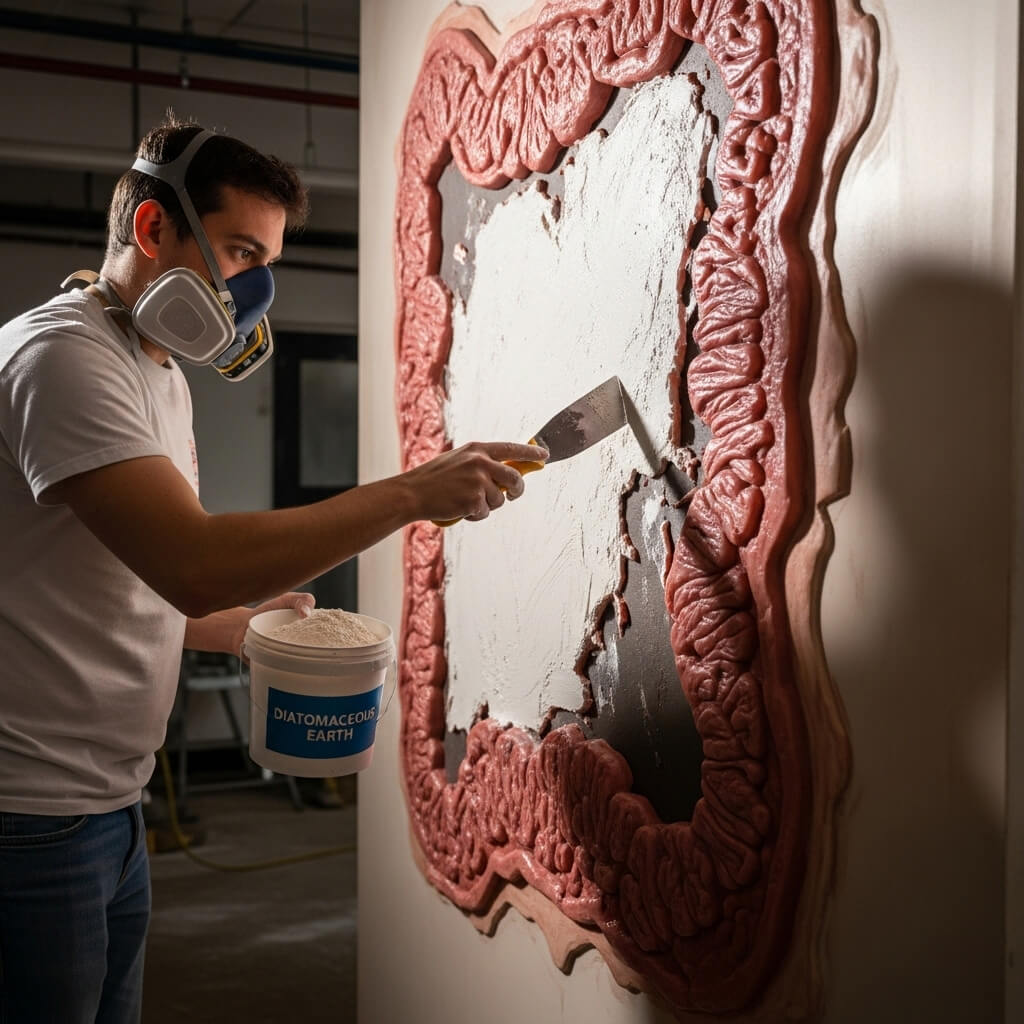
The perceived benefits people report appear to have several non-absorption explanations. The placebo effect plays a significant role, particularly given DE’s marketing as a “detoxification” agent and the lack of controlled studies. DE acts as a bulk-forming agent similar to dietary fiber, which can temporarily affect bowel movements – some users experience constipation relief while others report increased constipation due to DE’s water-absorbing properties. The mechanical presence of particles in the gut may cause digestive changes that users interpret as “cleansing,” though no evidence supports actual detoxification occurring.
Health risks hiding in the powder
Food-grade diatomaceous earth contains up to 2% crystalline silica, a substance classified as a Group 1 carcinogen when inhaled. While oral consumption poses less respiratory risk than occupational exposure, handling the powder during daily supplementation creates inhalation opportunities. Studies of diatomaceous earth workers show increased rates of lung cancer and respiratory disease, raising concerns about cumulative exposure from daily use.
DE’s absorptive properties, touted as beneficial for “detoxification,” actually create drug interaction risks. The material can bind to medications, potentially reducing their effectiveness. This proves particularly concerning for drugs with narrow therapeutic windows where small absorption changes can have clinical consequences. Patients must separate DE consumption from medications by several hours, though specific interaction studies remain absent from the literature.
The intestinal changes documented in recent research suggest potential for nutrient malabsorption. The thickened mucus layer and reduced expression of transport proteins could interfere with absorption of fats and fat-soluble vitamins. Combined with DE’s known binding properties, chronic consumption might contribute to nutritional deficiencies – an ironic outcome for a supposed health supplement.
Perhaps most concerning is the complete absence of long-term safety data. No studies have examined what happens with months or years of daily DE consumption. The FDA has not approved DE for direct human consumption as a supplement, only as an indirect food additive for filtration and anti-caking purposes. In 2019, the FDA issued warning letters to companies making health claims about DE products, noting they were being marketed as unapproved drugs.
Silicon sources that actually work
For those seeking bioavailable silicon supplementation, science points to dramatically superior alternatives. Choline-stabilized orthosilicic acid leads the evidence-based options with 17% bioavailability and multiple randomized controlled trials demonstrating benefits for bone density, skin elasticity, and hair quality. The stabilization prevents polymerization, maintaining the monomeric form required for absorption.
Dietary sources provide readily bioavailable silicon without supplementation risks. Whole grains like oats and brown rice, green beans, and bananas offer silicon in naturally absorbable forms. Beer, particularly alcohol-free varieties, shows exceptional bioavailability at 60% due to silicon extracted from barley during brewing. These food sources provide 20-50mg of silicon daily in typical Western diets, meeting any physiological needs.
The often-promoted plant extracts fare poorly in comparison. Bamboo extract, despite containing 70% silicon, shows only 3-5% bioavailability and contains thiaminase which can interfere with vitamin B1. Horsetail extract provides just 5-7% silicon content with similarly poor absorption. Both cost significantly more than food sources while delivering less bioavailable silicon than a serving of oatmeal.
Why people feel better despite poor absorption
The mechanism behind reported benefits becomes clear when examining the evidence. With near-zero silicon absorption documented, systemic effects on bones, collagen, or connective tissue lack a plausible biological basis. Instead, the combination of powerful placebo effects from “detoxification” marketing, temporary digestive changes from DE’s mechanical presence, and confirmation bias in interpreting normal bodily variations as improvements explains most reported benefits.
Some users may experience genuine but misattributed improvements. Increased water consumption often accompanies DE supplementation due to its dehydrating effects. The ritual of taking a daily supplement can trigger positive behavioral changes. Temporary constipation relief from bulk-forming effects might improve overall comfort. These real but non-specific effects get incorrectly attributed to silicon supplementation or “detoxification” rather than their actual causes.
The single study suggesting cholesterol benefits suffers from fundamental flaws that make the results questionable. Without a control group, researchers couldn’t account for placebo effects, regression to the mean, or lifestyle changes participants might have made while enrolled in a “health study”. The fact that no researcher has attempted to replicate these findings in 25 years speaks to the scientific community’s skepticism about the results.
Conclusion
The scientific evidence reveals food-grade diatomaceous earth as an ineffective and potentially risky approach to silicon supplementation. With bioavailability near zero, only one flawed human study, documented intestinal structural changes, and multiple safety concerns, DE fails to deliver on its marketed promises. The perceived benefits appear to result from placebo effects and mechanical gut interactions rather than silicon absorption.
For those seeking silicon supplementation, choline-stabilized orthosilicic acid provides 17 times better bioavailability with actual clinical evidence of benefits. However, most people obtain adequate silicon from a varied diet including whole grains, fruits, and vegetables. The human body requires very small amounts of silicon, and no deficiency syndrome has been documented in humans eating normal diets.
The gap between marketing claims and scientific reality for diatomaceous earth is vast. Until rigorous, placebo-controlled studies demonstrate both safety and efficacy for long-term human consumption, the evidence strongly favors choosing proven alternatives or simply maintaining a nutritious diet rich in naturally bioavailable silicon sources.
Silica Sources
Biosil https://amzn.to/3HBPVbD
Their liquid drops are cheaper than the capsules. Liquid helps us adjust dosage.
30 capsules = 150mg = $19.99
120 capsules = 600mg $59.99
100 liquid servings = 600mg $32.99